A musician guide to Substack – strategy
As highlighted in Laura Fisher’s article ‘The Many Layers of Fandom’ on Midia Research, true fans want rich, continuous experiences that reward their curiosity and active participation. Substack’s narrative format perfectly nurtures these superfans, allowing creators to share long-form stories, exclusive insights, and personal connections that foster lasting loyalty. By prioritizing exploration and community over mere consumption, Substack becomes a haven for those who aspire to engage, interact, and invest deeply in the stories and creators they follow.
After exploring the platform’s main features and demonstrating how Substack has established itself in the music landscape, this second part will focus on practical questions. Through examples and advice, David Percy, Deputy Head of Audience Development at IDOL, unpacks the best practices that enable artists and labels to build a loyal audience and foster dialogue with this promising public.
This time, it’s about concrete feedback, personalized strategies, and tips for building and growing a community.
How, concretely, can you create a community on Substack?
There is necessarily traffic coming from social networks. If the artist has a large audience on Instagram, we will tend to direct them to Substack, for example, by putting the link in the bio or by reserving certain exclusive content on Substack to encourage subscriptions. But Substack also offers the possibility of direct discovery on the platform.
What works well is this feed system that allows you to search for new artists or new content. Substack offers an “explore” tab that really gives the user control. It’s not like on TikTok or Instagram, where the vertical feed quickly ends up suggesting content biased by the algorithm, and where you no longer find the accounts you subscribed to. On Substack, the discovery feed and the feed reserved for followed accounts are clearly distinct.
With the explore tab, it’s the user who chooses: you can filter by themes, by new trends, by category (culture, tech, politics, food, etc.), so you become an actor in your own discovery, a bit like in a media. I think that appeals a lot to those who are tired of endless scrolling on other networks.
What features are recommended to generate exchange between fans and artists?
On Substack, it’s super easy to get in touch with your fanbase. Like on many other platforms, there’s a chat to send direct messages to your subscribers. But there’s also an “activity” tab, which looks a bit like the Instagram or Twitter feed: you can highlight your own publications and those of other accounts, especially fans, and see all interactions in one place. This really helps to value and animate the fanbase.
There are also chat rooms: you can create discussion spaces, reserved for paying subscribers, where everyone can chat at the same time, on particular themes. It’s a bit like having a mini-Discord integrated into your Substack space. You decide if these threads are accessible to everyone or only to certain subscribers, depending on different payment levels, for example.
And of course, in parallel, there’s the newsletter and exclusive content that allow you to maintain a direct and privileged link with superfans.
Globally, you keep control over everything, with plenty of tools to create a real community dynamic: discussions, threads, and different exchange spaces between fans.
Are there good publishing practices?
To succeed on Substack, it’s best to start by offering something that truly has value, even in free content: exclusive previews, behind-the-scenes moments, anecdotes about the creative process… And what works best is to be authentic, because that allows you to create a real relationship of trust with your audience.
You also need to publish regularly. Regardless of the frequency, the important thing is to be consistent, even if it’s every two weeks or once a month. And vary the formats, with audio excerpts, images, videos…
If you decide to offer several types of content (free, paid, tutorials, release announcements…), you’ll need to think about organizing the page so that everyone can follow what interests them. I recommend using the discovery functions: placing keywords on striking titles, recommending other Substack profiles, participating in the community, and not hesitating to ask others for a recommendation, because all these actions will help to expand the fanbase.
Finally, don’t neglect to check the analytics to see what types of publications work, open rates, what generates the most engagement, what triggers subscriptions or sales… All of this will help to adjust the content offered to satisfy the community.
The paid part really requires upstream work: you must have already proven the value of the free content and have a solid base before asking people to take the plunge and subscribe.
What frequent pitfalls should you avoid and how can you circumvent them?
The first thing to respect is to avoid doing only promotion or only posting announcements. If every post is just “buy my merch, listen to my new single, here are my tour dates,” people will quickly unsubscribe. You have to vary, provide value, tell stories, share inspiration, art…
Regarding monetization, you shouldn’t rush. You need to offer free content, introduce your universe first, then gradually offer paid content or bonuses. If the free audience grows well, it means the content is solid enough to move to paid. If everything is locked from the start, it risks hindering community growth. The idea is to test, adjust, and move at your own pace.
Above all, don’t forget the newsletter part: it’s tempting to put everything on web posts or social networks, but the real strength of Substack is that content arrives directly in people’s inboxes.
Above all, don't forget the newsletter part: it's tempting to put everything on web posts or social networks, but the real strength of Substack is that content arrives directly in people's inboxes.
On Substack, it’s easy to get scattered. It’s better to post less, but focus on solid content than to try to do everything at once and end up rushing your publications. Also pay attention to technical quality: even if authenticity matters, poorly formatted posts, buggy audio, poor quality images, all of this undermines credibility.
You also shouldn’t ignore reader feedback. Comments, messages… These are great opportunities to understand what works or doesn’t, to adjust content, and to strengthen the bond with your community.
Finally, don’t put all your eggs in the Substack basket! It’s just another tool; you also need to maintain a presence on streaming platforms and social networks. Everything is part of the ecosystem; that’s what gives strength to the project’s overall strategy.
What inspiring examples of music/label pages illustrate good practices today?
The artists present on the platform are mostly “vintage” figures or very “cool kid” alternative artists, but not necessarily mainstream/pop. If they use Substack, it’s because these artists needed to create a space for expression that they wouldn’t have had otherwise. Very mainstream artists don’t necessarily need it; they already have all the classic channels available.
For several years now, Patti Smith has been using her page as a real hub: she shares a kind of diary, essays, videos, photos that she comments on, which creates a very personal and immersive experience.
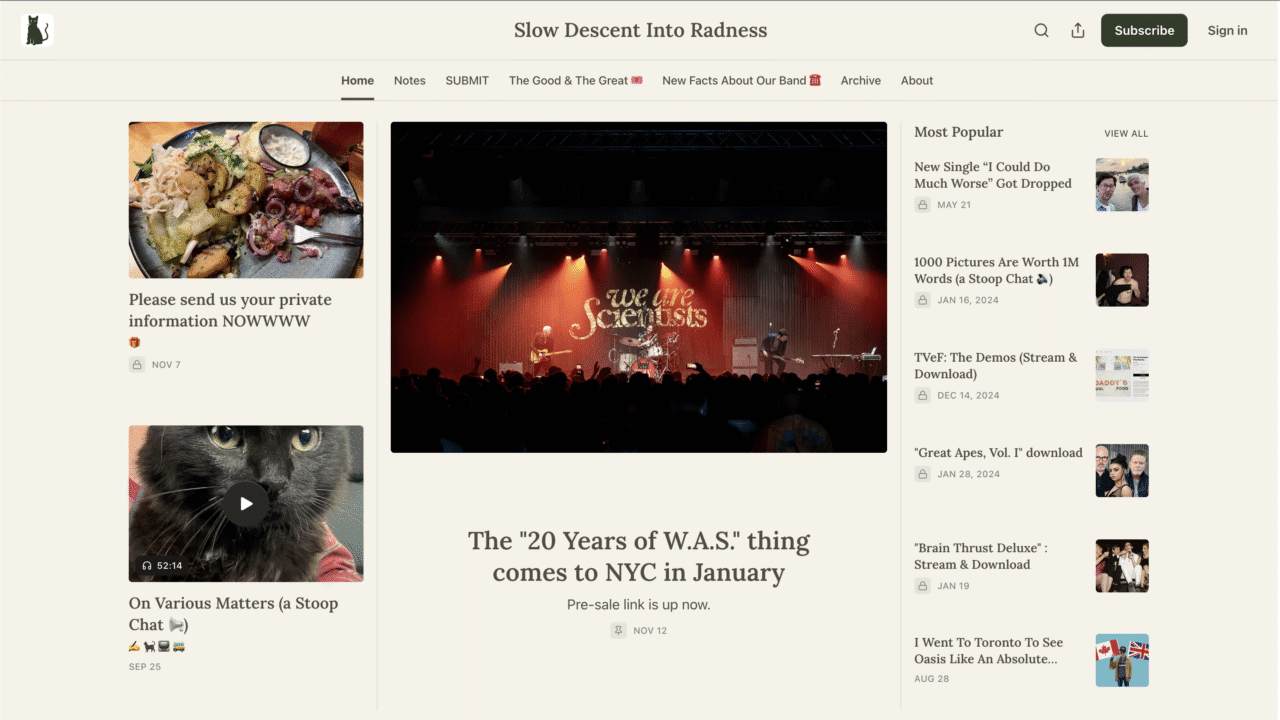
Laura Marling, on the other hand, adopts a somewhat Twitter-like approach: short, regular messages, with a lot of direct exchanges, which makes her page super lively. We Are Scientists have a page designed like a real journal: very editorialized, like a magazine about their news and reflections.
On the side of more emerging or alternative artists, Sessa from Mexican Summer just launched a few weeks ago and already has 1500 subscribers, so he’s a profile to follow! There’s also Lucky Break who is with Fire, who uses it completely as a logbook.
In short, there are many ways to use Substack: diary, news feed, multimedia space, and everyone adapts it to their universe and their sharing desires.